Tooth Fairy Rates 2026: How Much Should the Tooth Fairy Leave?
The 2026 Tooth Fairy average is $5.84 per tooth and $7.17 for a first tooth, per the Delta Dental poll. See rates by region, age, budget level, plus parent tips.
Last updated: June 8, 2026
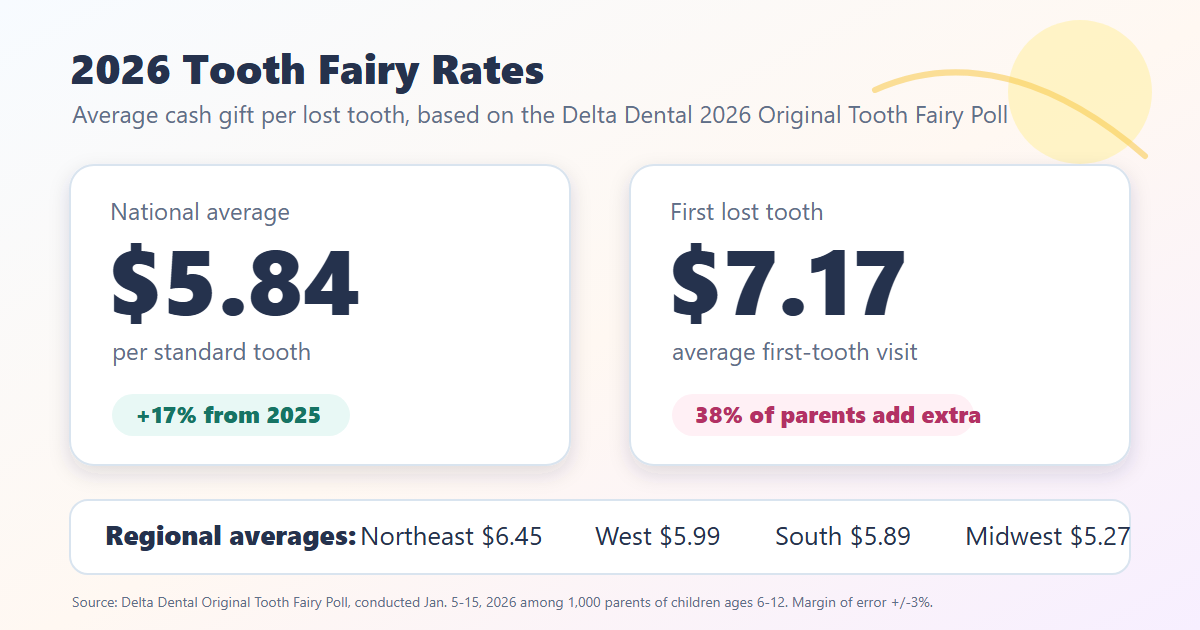
The average Tooth Fairy payout in 2026 is $5.84 per tooth, a 17% increase from $5.01 in 2025, according to the Delta Dental 2026 Original Tooth Fairy Poll. A child's first lost tooth averages $7.17—about 23% more than a standard tooth. This is the first year-over-year increase since 2023, ending a two-year decline.
If your child loses all 20 baby teeth at the national average, the Tooth Fairy's career total comes to about $116.80.
But the "right" amount for your family depends on your budget, your child's age, and whether you want to include non-cash gifts. Below you'll find rate tables, regional breakdowns, and practical guidance—not pressure to hit any specific number.
2026 Tooth Fairy Rate Table
By Tooth Milestone
| Milestone | National Average (2026) | Change from 2025 | Source |
|---|---|---|---|
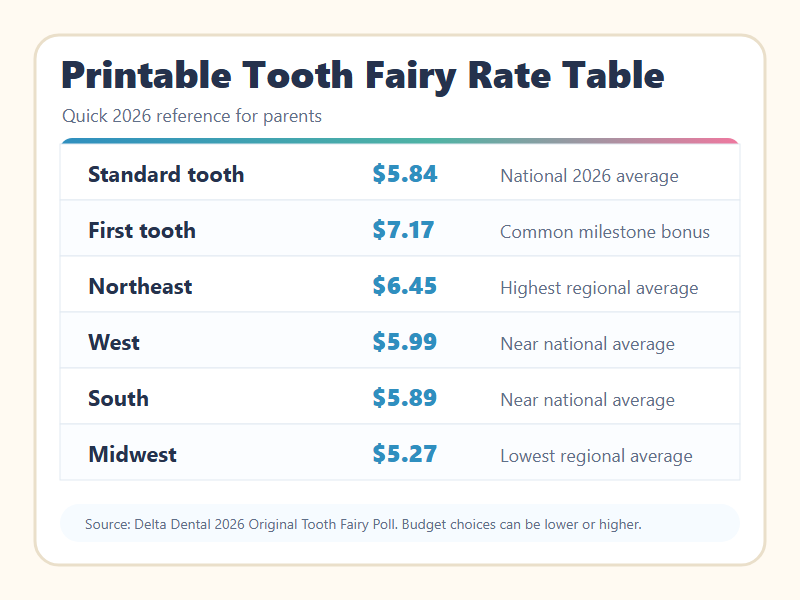
| Standard tooth | $5.84 | +17% (from $5.01) | Delta Dental 2026 Poll |
| First lost tooth | $7.17 | +15% (from $6.24) | Delta Dental 2026 Poll |
| Last baby tooth | No official data | — | Many parents match or exceed the first-tooth amount |
38% of parents say the Tooth Fairy leaves extra for the first tooth. (Source)
By U.S. Region
| Region | Average Per Tooth (2026) | Year-over-Year Change |
|---|---|---|
| Northeast | $6.45 | +41% |
| West | $5.99 | +5% |
| South | $5.89 | +3% |
| Midwest | $5.27 | +52% |
Source: Delta Dental 2026 Poll; Axios analysis
By Family Budget Level (Practical Guide)
The Delta Dental poll reports national averages, but every family is different. Here's a practical guide based on the 2026 data and common parent approaches:
| Budget Level | Per Tooth | First Tooth | Notes |
|---|---|---|---|
| Budget-friendly | $1–$2 | $3–$5 | A coin or two plus a short note. The magic is in the experience, not the dollar amount. |
| Middle range | $5–$6 | $7–$8 | Aligns with the 2026 national average. A bill and a personalized letter. |
| Generous | $10–$20 | $15–$25 | Often includes a small gift, book, or experience alongside cash. |
| Non-cash focused | $1–$2 + gift | $3–$5 + gift | 32% of children received a non-cash gift in 2026. Stickers, books, or a personalized Tooth Fairy letter work well. |
Budget-level ranges are editorial estimates based on the 2026 Delta Dental regional data and common parent practices, not official survey categories.
Historical Tooth Fairy Rates (1998–2026)
Since Delta Dental began its poll in 1998, the average payout has risen 349%—from $1.30 to $5.84:
| Year | Average Per Tooth | Notable Trend |
|---|---|---|
| 1998 | $1.30 | First year of the poll |
| 2006 | $2.09 | Gradual climb through the 2000s |
| 2013 | $3.50 | Crossing the $3 mark |
| 2018 | $3.70 | Plateau period |
| 2021 | $4.03 | Modest bump during the pandemic era |
| 2022 | $5.36 | Sharp 33% increase |
| 2023 | $6.23 | All-time record high |
| 2024 | $5.84 | 6% decline from the record |
| 2025 | $5.01 | 14% decline, lowest since 2021 |
| 2026 | $5.84 | 17% rebound; back to 2024 level |
Historically, the Tooth Fairy Index has tracked with the S&P 500. In 2026, the 17% tooth rate increase aligned with a 16% S&P 500 gain over the same period. (Source)
Global Tooth Fairy Rates
Curious how U.S. rates compare worldwide? Delta Dental provides international equivalents:
| Country | Average Per Tooth (Local Currency) | USD Equivalent (approx.) |
|---|---|---|
| United States | $5.84 | $5.84 |
| Canada | C$8.00 | ~$5.80 |
| Ireland | €4.96 | ~$5.40 |
| Spain | €4.96 | ~$5.40 |
| England | £4.34 | ~$5.50 |
| Japan | ¥904 | ~$5.80 |
| Brazil | R$30.57 | ~$5.50 |
| Costa Rica | ₡2,808 | ~$5.30 |
Source: Delta Dental Global Tooth Rates. USD equivalents are approximate based on mid-2026 exchange rates.
What About Non-Cash Gifts?
In 2026, 32% of children received a non-cash gift from the Tooth Fairy, up from 19% in 2025. This is a significant trend shift. Popular non-monetary gifts include:
- A personalized Tooth Fairy letter — Create a free one here
- Stickers, temporary tattoos, or small art supplies
- A children's book about teeth or growing up — see our best children's books guide
- A special toothbrush or fun dental care item
- A small toy or figurine
- An experience coupon (movie night, ice cream date, extra story at bedtime)
For more creative ideas, see our full guide to Tooth Fairy money ideas beyond coins.
How Much Should YOU Leave? A Parent's Decision Framework
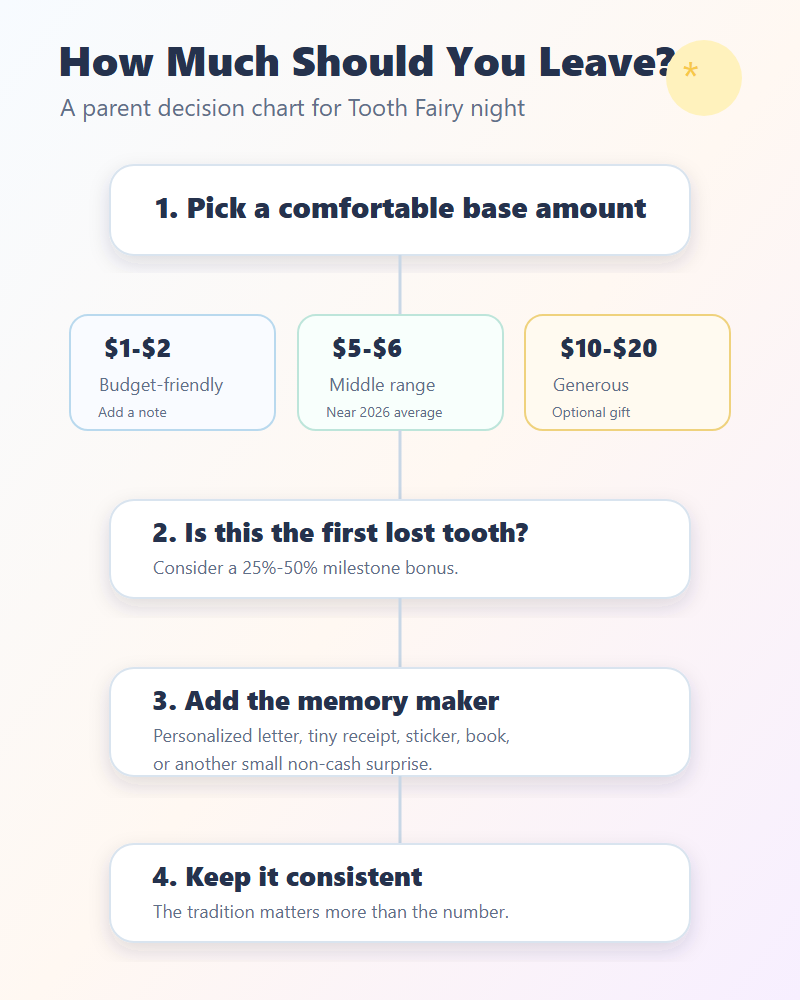
Forget the averages for a moment. Here's a practical framework:
- Pick a base amount you're comfortable with. $1, $5, or $10—all are fine. The number matters far less than consistency and the experience around it.
- Decide on a first-tooth bonus. Most parents leave 25–50% more for the first tooth. If your base is $5, leaving $7–$8 for the first tooth aligns with the national data.
- Consider whether you'll include a letter or gift. A free personalized Tooth Fairy letter costs nothing and often becomes the most treasured part of the visit.
- Stay consistent across siblings. Kids talk. Whatever you choose, try to keep it roughly consistent for each child.
- Don't stress about keeping up. The Delta Dental poll reflects averages across 1,000 families with widely varying incomes and regions. Your family's tradition is yours.
"After a couple of thrifty years, the Tooth Fairy decided it was time to give kids a well-deserved raise." — Gabriella Ferroni, Delta Dental (Source)
Magic Matters More Than Money
Here's what the survey data doesn't capture: children remember how the Tooth Fairy visit felt, not how much money was under the pillow. A handwritten note, a sprinkle of biodegradable glitter, or tiny footprints made from flour leave a deeper impression than an extra dollar.
Ways to make the visit magical without spending more:
- Leave a personalized Tooth Fairy letter — free and takes 30 seconds
- Sprinkle "fairy dust" (biodegradable glitter) on the windowsill
- Use a special Tooth Fairy letterhead template for an official look
- Write the note in a different color ink than you normally use
- Leave tiny fairy footprints using baby powder and a doll shoe
For complete visit ideas, see our first Tooth Fairy visit guide and our guide on what to do when the Tooth Fairy forgets.
Methodology and Sources
The primary data source for this article is the Delta Dental 2026 Original Tooth Fairy Poll, conducted January 5–15, 2026, among 1,000 parents of children ages 6–12. The margin of error is ±3%. Delta Dental has conducted this poll annually since 1998, making it the longest-running and most widely cited Tooth Fairy spending survey in the United States.
What the poll measures: Average cash gift per lost tooth, first-tooth premium, regional breakdown, and non-cash gift frequency.
What it doesn't measure: Rates by specific age, tooth type (incisor vs. molar), or income bracket. The budget-level table in this article is an editorial guide based on the survey averages and regional data, not a separate survey. Where we estimate, we say so.
Sources cited:
- Delta Dental 2026 Original Tooth Fairy Poll (press release)
- Delta Dental Historical Poll Data
- Axios: "Tooth fairy rate 2026"
- Reader's Digest: "The Tooth Fairy Is Paying More Than Ever"
- Newser: "Inflation Hits Parents a New Way"
- FOX 35 Orlando: "Tooth Fairy paying out more"
Frequently Asked Questions
How much does the Tooth Fairy leave in 2026?
The national average is $5.84 per tooth, according to the 2026 Delta Dental Original Tooth Fairy Poll. This is a 17% increase from $5.01 in 2025.
How much does the Tooth Fairy leave for a first tooth?
The average first-tooth payout in 2026 is $7.17—about 23% more than a standard tooth. 38% of parents say the Tooth Fairy leaves extra for the first tooth.
What is the Tooth Fairy rate by region in 2026?
The Northeast leads at $6.45, followed by the West ($5.99), South ($5.89), and Midwest ($5.27). The Midwest saw the largest year-over-year jump at 52%.
Is $1 too little for the Tooth Fairy?
No. There's no wrong amount. The averages reflect a wide range of family budgets. $1 plus a personalized Tooth Fairy letter or small gift creates a meaningful experience. The magic comes from the tradition, not the dollar amount.
Should the Tooth Fairy leave the same amount for every tooth?
Most parents keep a consistent base amount and add a small bonus for milestones like the first and last tooth. Consistency helps avoid "why did my sibling get more?" conversations.
What percentage of kids get non-cash gifts from the Tooth Fairy?
In 2026, 32% of children received a non-cash gift, up from 19% in 2025. Popular gifts include small toys, books, stickers, and personalized letters.
How much has the Tooth Fairy rate changed over time?
Since the Delta Dental poll began in 1998, the average has risen 349% from $1.30 to $5.84. The all-time high was $6.23 in 2023.
Where does the Tooth Fairy money data come from?
The most widely cited source is the Delta Dental Original Tooth Fairy Poll, conducted annually since 1998 among 1,000 parents of children ages 6–12.
Related Resources
- Free Tooth Fairy Letter Generator — Create a personalized letter in 30 seconds
- Tooth Fairy Letter Templates & Certificates — 10 free printable templates
- Free Tooth Fairy Letterhead Templates — Printable stationery designs
- Tooth Fairy Money Ideas Beyond Coins — Creative gift alternatives
- First Tooth Fairy Visit Guide — Make the first visit magical
- Tooth Fairy Forgot Guide — Rescue plans for missed visits
- Why Tooth Fairy Rates Don't Matter — Perspective on what really counts